
May is Foster Care Awareness Month
How to be a healing presence for children in foster care

Healing Presence
As a nurse, I find myself drawn to Bible stories about disease and healing. Not to note best practices, but to note God’s intimate involvement in the physical well-being of His people.
In my observation, no healing, miraculous or not, occurs in isolation. Whether through prayer, anointing, dipping, or touching, every healing occurs in the presence of a mediator, a healer, or an observer.
Except one.
Before taking His last breath, Jesus’s whipped and beaten body endured a gruesome crucifixion. Physicians hypothesize that Jesus’s chest cavity filled with blood, compressing both his lungs and his heart, leading to death by either asphyxiation or cardiac rupture.[1]
Healing rarely happens in isolation
The Scriptures offer no medical clarity on the cause of His death, but they do assure us that Joseph of Arimathea wrapped His lifeless body in a cloth and laid it in a tomb. When the women returned to the tomb with spices and ointments to tend to His crucified body, they found it empty (Luke 23:56).
Days later, Jesus appeared to His disciples, alive, walking, talking, and eating. As they stared in disbelief, He invited them to place their hands where spears and nails had pierced Him days earlier (Luke 24:39; John 20:27). Rather than touching fresh wounds, the disciples brushed their fingers over scars—scars that became an eternal testimony to Jesus’s identity.
As I ponder the resurrection account, I brush past the miraculous to the practical.
Jesus, I ask, who witnessed your healing?
What happened in the moments between His last breath on the cross and His emergence from the tomb? Did heavenly hosts watch as His heart beat again and His lungs filled with air? Did the Father and the Spirit tend to the wounds of the Son? I don’t know.
But any speculation leads me to marvel, and remember that His wounded, resurrected body does inform my nursing practice.
The power of being present in moments of pain
As a nurse, sometimes I offer medication to alleviate pain, or I gently tend to a wound to prevent infection. But regardless of the intervention, I offer presence first. A patient is more than a number, a disease, or a treatment.
But unfortunately, amid the hubbub and beeping of medical equipment, patients can feel unseen, unheard, and unknown. Until someone stops, listens, and offers presence. Even critically ill patients benefit from the presence of one gentle, calming individual.
This is the heartbeat of foster care.
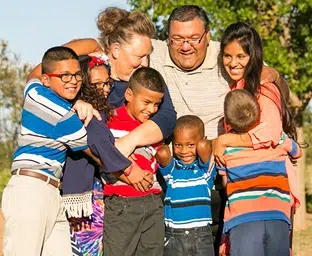
Children and teenagers enter foster care or kinship care deeply wounded— emotionally, spiritually, and sometimes physically—to no fault of their own.
The medical and emotional needs of children in foster care
Ruptures in relationships, lack of medical care, and past or ongoing trauma can predispose children in foster care to a higher prevalence of health, developmental, mental health, behavioral, educational, and dental problems.[2] Up to 80% of children who come into care have at least one physical health problem, and one in three have a chronic medical condition.[3]
As the Domestic Foster Care and Adoption Registered Nurse at Buckner, I focus on the medical needs of children and teenagers in our care. I serve as a witness to their wounds, an advocate in a complex medical system, and a support for foster and kinship families, because healing should never begin in isolation.
We acknowledge that some children will have chronic medical conditions for the rest of their lives, and yet that does not quell the need for presence but amplifies it. Every child and teenager, regardless of background, diagnosis, or treatment, needs the presence of safe adults. More than 30,000 children and teenagers wait in the Texas foster care system.[4]
So, where might God be inviting you to be a healing presence?
But before stepping in, we remember that the wounds of our resurrected Savior heal us. Then, we join Him in offering comfort to others, praying that their wounds might become scars testifying to the healing presence of God (Isa 53:5; 2 Cor 1:3-4).
If you want step into the kingdom work of becoming a foster parent, then join us for a live virtual information meeting. Visit https://www.buckner.org/foster-care-adoption/ to sign up.
[1] Habermas, G., Kopel, J., & Shaw, B. C. F. (2021). Medical views on the death by crucifixion of Jesus Christ. Proceedings (Baylor University. Medical Center), 34(6), 748–752. https://doi.org/10.1080/08998280.2021.1951096
[2] Broussard, C. A., Fortin, K., Greiner, M. V., Szilagyi, M., & Council on Foster Care, Adoption, and Kinship Care, American Academy of Pediatrics (Eds.). (2025). Fostering Health: Health Care for Children and Adolescents in Foster Care (3rd ed). American Academy of Pediatrics. xvviii.
[3] Szilagyi, M. A., Rosen, D. S., Rubin, D., Zlotnik, S., Council on Foster Care, Adoption, and Kinship Care, Committee on Adolescence, & Council on Early Childhood (2015). Health Care Issues for Children and Adolescents in Foster Care and Kinship Care. Pediatrics, 136(4), e1142–e1166. Https://doi.org/10.1542/peds.2015-2656.
Related Posts